
Use
Create a POS
If no point of sale exists yet in the database, a set of POS cards is displayed on the Point of Sale Dashboard. Each card represents a business type. Click a card to create a POS with preconfigured settings tailored to that type. These settings can be adjusted later as needed.
To create additional POS or to create one from scratch, go to and click New. Then, configure the POS settings to meet your specific business requirements.
Note
Click Configurations > Settings to access more settings.
Important
Assign a dedicated cash payment method and cash journal to each POS. This ensures that accounting entries are separated and traceable to specific points of sale.
Access the POS settings
To access the general POS settings, go to . Then, open the Point of Sale dropdown menu and select the POS to configure.

Tip
To configure basic settings, access the POS dashboard, click the (vertical ellipsis) icon on the relevant POS card, then select Edit. In the popup window, you can:
Open the POS register
Once the POS is fully configured, access the POS interface by opening the register. Navigate to and:
On the relevant POS card, click Open Register.
In the Opening Control popup, ensure the Opening cash amount is correct.
Click Open Register.
Note
Once the register is open, Open Register is replaced by Continue Selling on the POS card.
You can switch between multiple users from an open POS register, provided multi-employee management is enabled.
From the POS interface header:
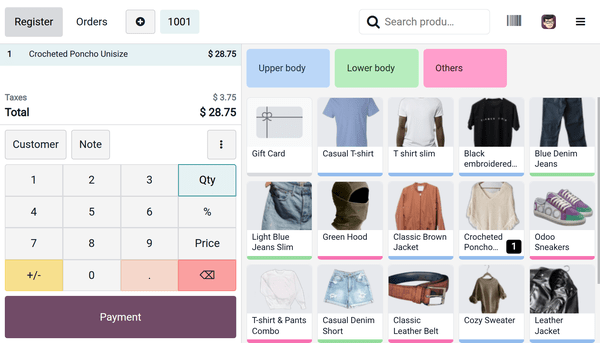
Click Register to access the register for daily POS actions such as sales, refunds, etc.
Click Orders to access the POS orders overview screen and retrieve past or ongoing orders.
Click the (plus) icon to put the current order aside and start a new one.
Click the order numbers to switch between ongoing orders.
Search for products using the search bar.
Click the (barcode) icon to use a webcam as a barcode scanner.
Click the user’s avatar to switch between employees, provided multi-employee management is enabled.
Click the (hamburger menu) icon to access more advanced options, such as closing the register.
Sell products
The POS register can be divided into three sections: the cart, a pad to adjust cart items, apply discounts, set customers, etc., and the list of products. To make sales:
Click on products to add them to the cart.
To change the quantity, click Qty and enter the number of products using the keypad.
To add a discount, click % and enter the discount value using the keypad.
To modify the product price, click Price and enter the new amount using the keypad.
Once the order is completed, click Payment to proceed to checkout.
Select the payment method.
Enter the received amount, then click Validate.
Click New Order to move on to the next order.
Tip
You can use both
,and.on the keyboard as decimal separators.Cash is selected by default if no payment method is manually selected.
Set customers
Registering customers is necessary to collect their loyalty points and grant them rewards, automatically apply an attributed pricelist, or generate and print invoices.
To create customers from the POS register:
Click Customer.
Click Create.
Complete the customer form information and save.
To create customers from the backend:
Go to .
Click New.
Fill in the customer form information.
To assign a customer to an order, click Customer to access the customer list on the POS register or the payment screen, and select the desired customer.
Note
Creating a new customer from the POS register or the payment screen assigns them automatically to the current order upon saving.
Send marketing messages
Customers’ contact details, such as their phone number or email addresses, are stored automatically when sending receipts by email, SMS or Whatsapp. They can then be used, for example, for Point of Sale ‣ Orders ‣ Orders, open a POS order form, navigate to the Contact Info category under the Extra Info tab, then click the (email) icon or (whatsapp) icon.
See also
Orders overview
The Orders overview allows for viewing, searching, and retrieving orders from the POS interface. To access it, click Orders in the header.
Then, search for orders in the search bar using their:
Reference
Receipt Number
Date
Customer
Delivery Channel
Delivery Order Status
To filter orders based on their status, click the Active dropdown menu and select one of the following options:
Active: Orders currently in progress. This includes orders marked as Ongoing, as well as those in the Payment or the Receipt stages (i.e., orders for which the receipt has been emailed to the customer).
Paid: Paid orders.
To navigate between pages, click the or (caret) icon.
To access an order in the register, click it, then click Load Order.
Note
Paid orders can be refunded.
Tip
To define the number of orders visible on a page, click
1-x / x. Enter a number lower than the total number of pages, and click Ok.Click the (trash) icon next to an Active order to delete it.
If using presets, click one to view the related orders. Click it again to return to the main overview.
Return and refund products
To refund a returned product, follow these steps:
Open or access the register from the POS dashboard.
Click the (vertical ellipsis) button, then Refund.
Note
Alternatively, you can refund orders from the orders overview screen. Access the list of orders and filter them by status to display only Paid orders.
Select the relevant order from the order list.
Select the items and use the keypad to set the refund quantity, then click Refund.
Choose how to handle the refund:
To reimburse the customer, select a payment method on the payment screen, then click Validate.
To issue a gift card for the refund amount, click Back. A new order containing the returned items (with negative quantities) is created automatically. Then, add the gift card from the product list to the order; its value is set automatically to match the total refund amount. Click Payment, then Validate the refund.
Note
You cannot add other products to the cart until the refund has been validated.
Alternatively, refunds can be processed by:
Selecting the returned product(s) from the POS register and setting a negative quantity equal to the number of returned items. To do so, click Qty and +/-, and update the quantity accordingly.
Selecting the returned product(s) from the POS register and a preset set up for the return mode.
Accessing the POS dashboard, navigating to , selecting an order, and clicking Return Products.
Once the return is validated, a corresponding credit note is generated, referencing the original receipt or invoice.
See also
Notes
Notes allow you to attach extra information to specific products in an order. There are two types of notes: internal notes and customer notes.
Internal notes
Internal notes provide information meant for staff (e.g., no tomato for the kitchen). These notes
do not appear on the customer’s receipt. To add a note to an order, ensure no item is selected and
click Note. Likewise, to add a note to one specific item, select it from the cart and
click Note. Then, add or modify the note’s content in the popup that opens:
Type the note directly into the window, or
Use a configured note model to save time if the same content is frequently used. Click on the desired note model to insert its text.
To create or edit note models, navigate to , click New or the relevant note model, then complete or edit the Name column.
Customer notes
Notes for customers appear on receipts and invoices.
They can be used, for example, to provide warranty details for a high-value item or specific care
instructions, such as Dry clean only.
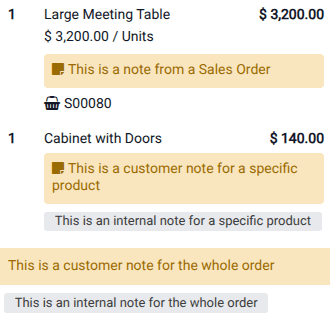
To add a customer note from the POS register to a specific item, select a product from the cart and click the (vertical ellipsis) button. Click Customer Note, then add the note’s content in the popup window.
Note
If no item is selected, the note applies for the whole order.
Product notes from an imported SO are displayed identically in the cart.
Manage the cash register
Axis POS allows you to determine which coins and bills are accepted. To set up the allowed coins and bills:
Navigate to .
Click New to add a new value.
Select the POS where this value is available in the Point of Sale column or leave the field empty to make it available for all POS.
To record a cash in or cash out transaction not associated with a sale:
Click the (hamburger menu) icon on the POS interface.
Click Cash In/Out.
In the popup that opens, select Cash In or Cash Out.
Enter the amount.
Specify the reason for the addition or removal of cash, and Confirm.
Note
Only employees with basic or advanced access rights are allowed to perform cash in/out actions.
Close the POS register
To close the POS register, click the (hamburger menu) icon, then Close Register.
In the Closing Register pop-up that opens, you can view:
The number of orders and the total amount made during the session.
The expected amounts grouped by payment method.
Click (money) to specify the number of each coin and bill.
Click Confirm to return to the previous pop-up window. The computed amount is set in the Cash Count field, and the Closing Details are specified in the Closing Note section.
Click Close Register to close the register and post accounting entries.
Tip
Click (clone) to automatically fill in the field with the expected cash amount.
Note
When the money counted does not match the expected amount, a Payments Difference window automatically pops up. Selecting Proceed Anyway validates the session and automatically posts the discrepancy to the designated cash difference journal.
Closing the register of a restaurant POS when orders are still in draft and not scheduled for later is not allowed and opens a pop-up window on which you can either Review Orders or Cancel Orders.
It is strongly advised to close the POS register at the end of each day.
See also